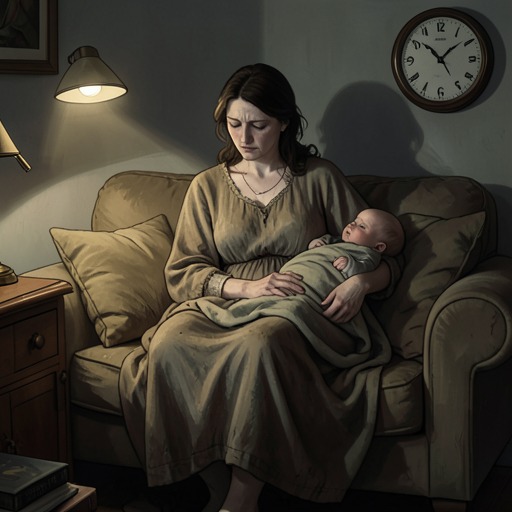
Heidi’s postpartum distress and exhaustion
Along for the RideHeidi’s postpartum distress and exhaustion develop amid the relentless care of Thisbe and an unevenly shared household burden. The strain first appears as fatigue and difficulty keeping up with the baby, then becomes a frightening episode of silent weeping. Her crisis exposes how little help she has been receiving, while the practical support of Karen Stock and later changes in the family’s schedule begin to make care less solitary.
Early Signs and the Conditions of Exhaustion
When Auden visits the family’s beachside home, Robert explains that Heidi is tired because Thisbe is awake often at night. He adds that his own sleep condition means he has to get nine hours, leaving him with little capacity to help overnight, and says Heidi refuses to bring in assistance. His account identifies both the immediate physical pressure of interrupted sleep and a pattern that will recur: Heidi trying to manage everything herself while others describe that tendency without yet relieving it.
The burden is not confined to nighttime baby care. During a family dinner outing, Robert and Heidi argue over work: he has stopped early to spend time with the family, while Heidi insists that the employees waiting to be paid cannot simply be kept waiting. Their disagreement places the newborn’s needs alongside the demands of running a business and Robert’s wish to be present. It also echoes an earlier conflict in Auden’s family history, as Auden recognizes that the details have changed but the dispute over work and family time feels familiar.
Thisbe’s crying makes the imbalance visible in public. After the family reaches Last Chance, the baby wakes and escalates from fussing to screaming as the hostess prepares menus. Robert tries moving the stroller, then turns to Auden for help; Auden realizes what he wants and steps in, despite feeling that the expectation is unreasonable. The episode shows care passing to Auden in the moment, while Heidi is not there to take over and Robert is unable to settle the child.
Distress Becomes Impossible to Miss
The contrast between Robert’s excitement and Heidi’s depleted condition sharpens when he announces that he has finished his book. He enters Thisbe’s room eager to celebrate and proposes a dinner for the two of them. Heidi, still in the clothes she slept in, has red eyes and flattened, stringy hair; she looks so exhausted that she seems barely able to take in what is being said. Thisbe is squirming and screaming in her arms, and Heidi doubts that she can take the baby out. Robert suggests finding a sitter, but the scene makes plain that the prospect of celebration is being raised before Heidi’s immediate strain has been addressed.
The crisis becomes more acute when Robert is preparing to leave for what may be an overnight trip. Heidi says that Thisbe has been especially fussy, that she has not slept in a long time, and that she does not know whether she can manage. She asks whether Robert could wait a couple of weeks, until the baby is on more of a schedule. The request is a direct acknowledgment of need, but it comes only after a prolonged period in which she has found it difficult to ask him for help.
Later, Auden returns home expecting the familiar sound of Thisbe crying and instead finds the house quiet. In the dark living room, Heidi sits holding the baby and weeps continuously and silently. When Auden touches her leg, Heidi sobs harder; she does not answer and refuses at first to hand over Thisbe. Auden eventually takes the baby, and Heidi curls in on herself with her knees drawn to her chest and her face turned away. The change from the baby’s loud distress to Heidi’s quiet collapse makes her condition newly alarming to Auden. Unsure whom to call, Auden contacts Gas/Gro, hoping to reach someone who can help.
Practical Support and a First Change
Karen Stock comes to the house and sits beside Heidi. She speaks too quietly for Auden to hear, but Heidi listens; after a moment, she lets Karen draw her into an embrace and soothe her. The scene offers a concrete alternative to the expectation that Heidi must remain the capable caregiver: here, she is allowed to be comforted. Karen also stays overnight and tends to Thisbe, giving Heidi support that continues beyond the first emotional intervention.
The next morning, Heidi looks more rested and holds the swaddled baby. She tells Auden that Karen helped raise the baby’s mattress to reduce gas, suggested buying a swing to help Thisbe sleep, and knew how to advise her about sore nipples. These details matter because the help is specific to the conditions exhausting Heidi, not merely reassurance that she will feel better. Heidi is grateful that Auden brought Karen, while also admitting that she does not understand what happened the night before and that she had been extremely tired.
Auden’s account also places the crisis within a household still managing competing demands. Heidi is seen sweeping Robert’s office, which has been converted into a second guest room, while Thisbe watches from a bouncy seat. The image suggests a home being rearranged around the baby, even as domestic work continues. Karen’s intervention provides a needed pause, but the family’s routines and division of responsibility remain questions to be worked out.
Asking for Help and Reorganizing Care
In a later conversation, Heidi explains that since Thisbe’s birth she has been hesitant to ask Robert for help, partly because she is accustomed to doing everything herself and partly because he had not offered much. Karen has helped her recognize that Auden and Hollis were also Robert’s children and that raising a baby is a shared responsibility. Heidi has also been encouraged to make time for herself, including a girls’ night her friends had long wanted to arrange. She had delayed doing so until Karen and, later, Laura both reinforced the idea that she should accept support.
That change becomes visible when Heidi invites friends into the kitchen. Auden, studying alone upstairs, hears the gathering and sees Heidi with Maggie, Leah, Esther, and two other women, with Thisbe in her stroller and food spread across the table. The scene does not establish that her exhaustion has vanished; rather, it shows her making room for company and a social life while the baby remains present. For Auden, who has often experienced women’s conversation from a distance, the invitation to join makes Heidi’s renewed openness consequential beyond the household itself.
The longer-term response is a negotiated change in family arrangements. Heidi returns to Clementine’s part-time, while Robert reduces his teaching to one course so both can work and still spend time with Thisbe. On days neither parent can be home, Karen or Weymar students care for the baby. The arrangement does not erase the earlier crisis, but it distributes the practical work more widely than before. Robert continues trying to sell his novel and begins another, writing late at night despite getting less than his usual nine hours of sleep.
Significance
Heidi’s distress is portrayed through the conditions around her as well as through her visible collapse: repeated night waking, a crying infant, employment responsibilities, and a partner whose sleep and work impose limits on his availability. Her reluctance to ask for help compounds those pressures, but the narrative does not treat self-reliance as an adequate substitute for support. Auden’s intervention, Karen’s hands-on assistance, Heidi’s decision to make time for herself, and the later revision of work and childcare all mark steps toward a more shared system of care. The change is gradual rather than a sudden cure: the family moves from recognizing Heidi’s exhaustion to altering, however imperfectly, the arrangements that had left her carrying so much of it.